
Description
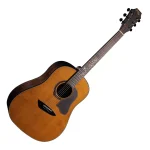
Gopherwood K250R Acoustic Guitar
Old‑school dreadnought power.
Gopherwood K250R NA
A round‑shoulder dreadnought voice with real authority on the low end—now paired with the openness of a roasted Sitka spruce top. Big and bold for strumming, clean and articulate for fingerstyle.
Sound Identity
Presence in the lows, openness in the highs.
The large air volume of the round‑shoulder dreadnought delivers palpable low‑end presence, while the roasted Sitka top adds open harmonics. Strumming: thick, high‑density sound pressure with confident attack. Fingerstyle: clean separation with a tidy, focused high‑mid.
Body Shape
Round‑shoulder dreadnought depth.
Depth 100 mm / 3.94″ (neck) · 125 mm / 4.92″ (endpin). Greater air‑cavity resonance enhances low‑end authority and adds natural reverb, elevating strum attack and acoustic output.
Tonewoods
Roasted Sitka clarity, mahogany mids.
Top: Solid roasted Sitka spruce. Back & Sides: African mahogany. Roasting stabilizes moisture and resins for a broken‑in, responsive feel even on a new instrument.
※ Roasted‑wood process: low‑oxygen, radiant‑heat treatment to simulate natural aging.
Bracing (3‑Layer Laminate)
Slimmer cross‑sections, deeper resonance.
A spruce–padauk–spruce sandwich structure enables slimmer cross‑sections at equal stiffness—deeper, longer body resonance while maintaining midrange density, with durability for long‑term use.
Neck Construction & Feel
One‑piece path for vibration.
A one‑piece neck integrated with the neck block streamlines the vibration path for fuller resonance and longer sustain. The soft‑V profile supports natural wrist angles for thumb‑over grips and barre chords.
Headstock & Hardware
Stability and sustain.
A thick rosewood headplate (front & back) reinforces pitch stability and sustain. The rear diamond volute stiffens a key stress area for added durability. 18:1 tuners provide precise, stable tuning.
Fretboard, Spacing, Nut & Saddle
Clear attack, refined look.
Rosewood fingerboard with maple inlays. Nut width: 44.5 mm (1.75″) · String spacing at nut: 37.2 mm (1.46″). Oil‑impregnated bone nut & saddle improve ground contact and energy transfer for a clearer attack and enhanced tuning stability.
Bridge (3‑Layer Laminate)
Tight lows, fast attack.
Rosewood – flame hard maple – rosewood laminated bridge in Ark geometry: stiffness where it counts with reduced mass to tighten lows and speed up single‑note attack. Left/right asymmetry fine‑tunes low/high balance.
Wood Pickguard & Rosette
Protection without damping.
A custom wood pickguard visually continues into the rosette—low‑mass, low‑thickness to avoid damping the top. The textured wood surface resists scratches and swirl marks.
Finish
Thinner film, bigger voice.
Ultra‑thin urethane gloss, ~35% thinner than the previous generation. Improved filler and electrostatic coating reduce excess film build, minimizing resonance loss and opening up overtones and touch dynamics.
SoundPillar (Removable)
Micro‑tune the resonance.
Maple body with ebony tip.
Installed: tidier overtones, flatter line/DI voicing, clearer mid focus—great for ensembles and recording.
Removed: fuller lows and enhanced damping for a more open, old‑school character.
SoundPillar
※ Internal tests include harmonic‑content changes across strings 6→1 and time‑domain frequency‑response shifts on an open E chord.